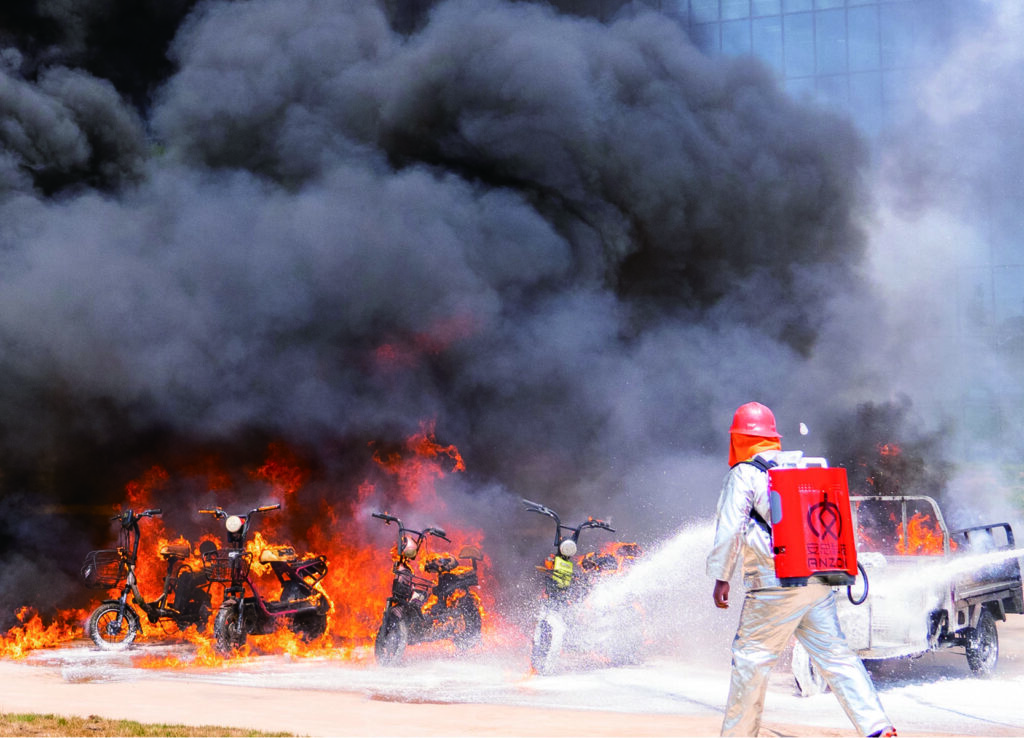
All tests conducted under real fire conditions. Data available upon request.
How It Works
How Aerogel Suppresses Fire
Aerogel-based fire suppression combines rapid cooling, oxygen isolation, and high-temperature resistant foam formation to stop combustion at its source.
Upon contact with heat, the water-based system rapidly absorbs heat energy, lowering surface temperature within seconds.
02.
Aerogel Foam Formation
Nano-porous silica aerogel forms a stable, heat-resistant foam layer that isolates oxygen and fuel.
03.
Anti-Reignition Protection
The solid aerogel skeleton structure prevents burn-back and significantly reduces re-ignition risk.
Aerogel vs Traditional Fire Extinguishers
Test results show significant performance differences between fire suppression technologies.
Choosing the right solution directly impacts safety, equipment protection, and long-term cost.
Criteria
⭐ Aerogel
Dry Powder
Foam (AFFF)
CO₂
Water
Fire Classes
A, B, E, F
A, B, C
A, B
B, E
A
Extinguishing Speed
⚡ Seconds
Fast
Medium
Fast
Slow
Re-ignition Risk
✅ None
⚠️ Possible
❌ High
❌ High
❌ High
Electrical Safety
Up to 36kV
Residue Risk
Not Safe
Safe
Not Safe
Cooling Capability
★★★★★
★
★★★
★
★★★★
Residue
Minimal
Heavy
Moderate
None
None
Equipment Damage
None
High
Medium
None
High
Environmental Impact
Eco-friendly (REACH)
Dust Pollution
PFAS Risk
CO₂ Emission
Low
Maintenance Cost
Low
Medium
Medium
Medium
Low
Full fire test reports and application-specific data are available upon request.
GET IN TOUCH
Why Aerogel Technology Delivers Superior Fire Protection
Eliminates re-ignition risk through stable foam barrier
Safe for lithium batteries and high-voltage equipment
Minimal residue, reducing equipment downtime and cleanup cost
Environmentally compliant and future-proof (REACH-ready)