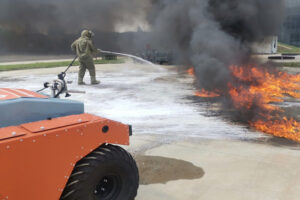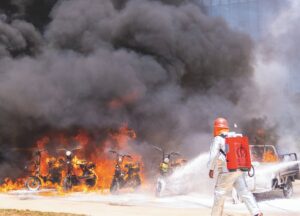
Oil and petrochemical fires are among the most dangerous and costly fire incidents in industrial environments.
From storage tanks to refineries, these fires involve extreme heat, rapid fuel vaporization, and high explosion risk. While foam systems are widely used, real-world incidents continue to expose their limitations.
So why does traditional foam fail — and what actually works?
Why Oil Fires Are Extremely Difficult to Control
Oil fires behave very differently from conventional solid material fires.
- Highly volatile fuels that vaporize under heat
- Rapid flame spread across liquid surfaces
- Intense thermal radiation
- High risk of explosion and escalation
In large storage tanks or petrochemical facilities, fires can escalate within seconds and become uncontrollable.
Why Traditional Foam Systems Fail
Foam has been the standard solution for decades — but it comes with critical limitations in high-temperature oil fire scenarios.
Foam Instability Under Heat
Foam layers break down quickly under extreme temperatures, losing their ability to isolate oxygen.
Poor Resistance to Oil Contamination
Certain fuels destroy foam structure, requiring continuous reapplication and reducing efficiency.
High Consumption & System Complexity
Foam systems require complex equipment and large volumes of agent. In many cases, system loss during application can reach up to 50%, significantly reducing effectiveness.
The Real Risk: Re-Ignition and Fire Spread
Because foam cannot fully stabilize the fuel surface:
- Fires may re-ignite after initial suppression
- Heat remains trapped within the fuel layer
- Fire can spread to adjacent tanks or systems
In petrochemical facilities, this can lead to chain reactions and catastrophic losses.
What Works Instead
Modern fire risks require more than surface-level suppression. Effective solutions must combine cooling, isolation, and long-term stability.
Instant Surface Sealing
Forms a dense barrier that seals the fuel surface and prevents vapor release.
Rapid Heat Reduction
Quickly lowers temperature, slowing down fuel vaporization and fire spread.
Anti-Reignition Protection
Creates a stable protective layer that prevents fire from reigniting.
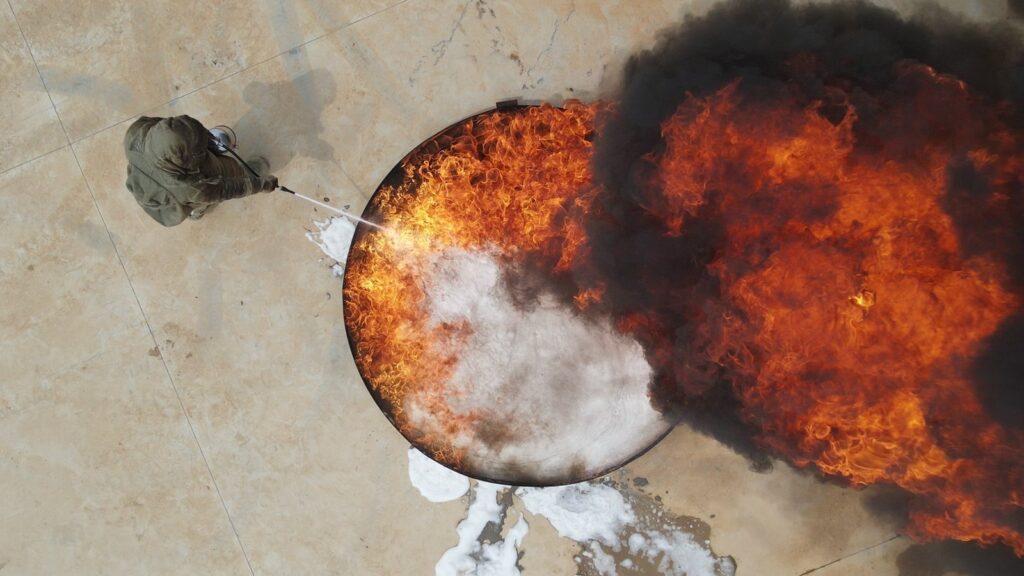
Verified Performance in Oil Fire Tests
- Extinguishing Time: as fast as 10 seconds
- No Re-Ignition: confirmed after suppression
- Stable Coverage: maintains surface sealing
These results represent a significant improvement over traditional foam systems.
Designed for Petrochemical Applications
This solution is particularly suitable for high-risk industrial environments:
- Oil storage tanks
- Refineries and chemical plants
- Pipeline leakage fires
- Fuel transport and storage systems
Environmental and Operational Advantages
- Lower agent consumption
- Reduced environmental impact
- Simpler deployment and system design
- Lower long-term maintenance cost
Conclusion
Traditional foam systems are no longer sufficient for modern petrochemical fire risks.
As fire scenarios become more complex, advanced suppression technologies are required to ensure safety and operational continuity.
Solutions that combine rapid cooling, oxygen isolation, and anti-reignition protection offer a clear advantage.
Protect Your Petrochemical Facility Today
Get expert fire protection solutions designed for oil storage, refineries, and industrial environments.
- Request detailed fire test reports
- Get customized fire protection solutions
- Consult with our engineering team
Contact us today to upgrade your fire safety strategy.