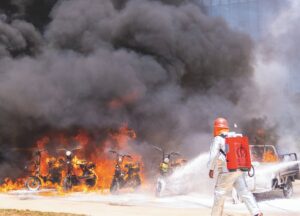
Lithium battery fires require a completely different approach compared to conventional fires.
As battery energy storage systems (BESS), EV charging stations, and electric vehicles continue to expand, choosing the right fire extinguisher is critical for safety and compliance.
In this guide, we compare the most common fire extinguishing methods and identify which solution actually works for lithium battery fires.
Why Lithium Battery Fires Are Different
Lithium battery fires are driven by thermal runaway — a self-sustaining reaction inside the battery.
Key characteristics include:
- Internal heat generation
- Release of flammable gases
- Re-ignition risk even after suppression
This means that simply removing oxygen or knocking down flames is not enough.
Effective suppression must:
- Cool the battery internally
- Stop thermal runaway
- Prevent re-ignition
Types of Fire Extinguishers for Lithium Battery Fires
1. Dry Powder Extinguishers
Pros:
- Fast flame suppression
- Widely available
Limitations:
- No cooling effect
- Cannot stop internal reactions
- High risk of re-ignition
2. CO₂ Extinguishers
Pros:
- Clean agent, no residue
- Suitable for electrical fires
Limitations:
- Ineffective against thermal runaway
- No cooling capability
- Short suppression duration
3. Foam Extinguishers
Pros:
- Covers fire surface
- Provides some cooling
Limitations:
- Limited penetration into battery cells
- Breaks down under high heat
- Cannot fully prevent re-ignition
4. Water-Based Systems
Pros:
- Strong cooling capability
- Can reduce temperature
Limitations:
- Limited effectiveness in sealed battery modules
- Electrical safety concerns
- May require large volumes
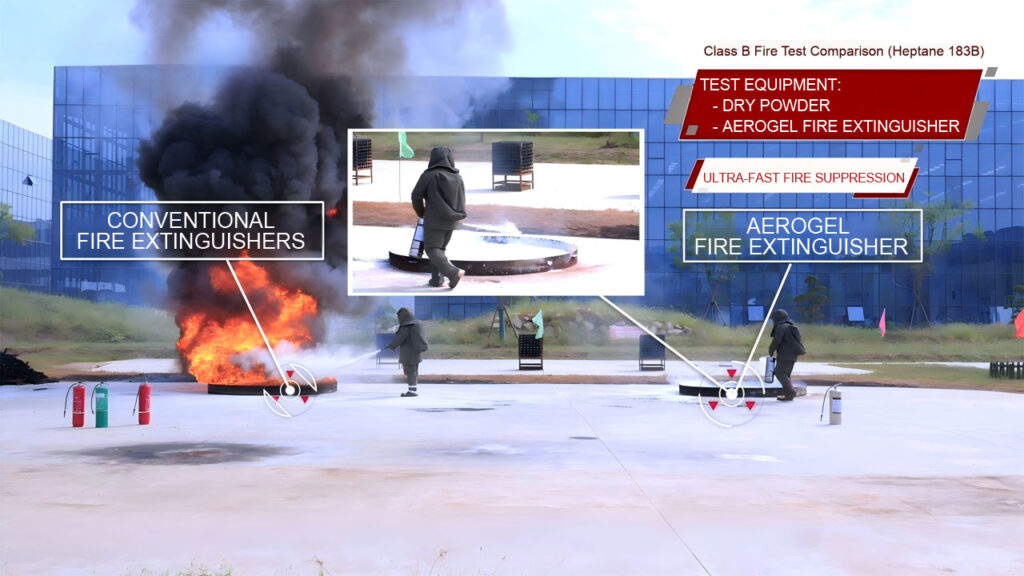
5. Aerogel Fire Suppression (Advanced Solution)
Pros:
- Rapid cooling and heat absorption
- Penetrates battery structures
- Forms stable barrier layer
- Prevents re-ignition
Limitations:
- Requires specialized systems
Comparison Summary
| Method | Cooling | Re-Ignition Prevention | Effectiveness |
|---|---|---|---|
| Dry Powder | Low | No | Medium |
| CO₂ | Low | No | Low |
| Foam | Medium | Limited | Medium |
| Water | High | Limited | Medium |
| Aerogel | High | Yes | High |
What Makes a Fire Extinguisher Effective?
For lithium battery fires, the best solution must provide:
- Deep cooling capability
- Thermal runaway interruption
- Long-lasting protection
Without these, fire suppression is incomplete.
Recommended Solution
Based on performance and test data, aerogel-based fire suppression offers the most comprehensive protection for lithium battery fires.
It not only extinguishes flames but also:
- Controls internal battery temperature
- Prevents re-ignition
- Reduces smoke and toxic gases
Where This Matters Most
Choosing the right fire extinguisher is critical for:
- Battery Energy Storage Systems (BESS)
- EV charging stations
- Electric vehicle facilities
- Data centers
- Industrial battery operations
Conclusion
There is no one-size-fits-all fire extinguisher — but for lithium battery fires, traditional solutions fall short.
Cooling and re-ignition prevention are the key factors that determine real effectiveness.
Advanced fire suppression technologies provide a safer and more reliable approach for modern energy systems.
Need Help Choosing the Right Fire Protection Solution?
- Get expert recommendations based on your application
- Request technical specifications and fire test reports
- Explore customized fire suppression systems
Contact our team to find the best solution for your facility.