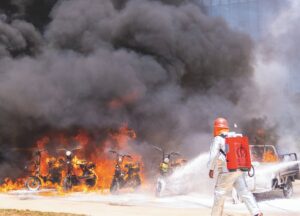
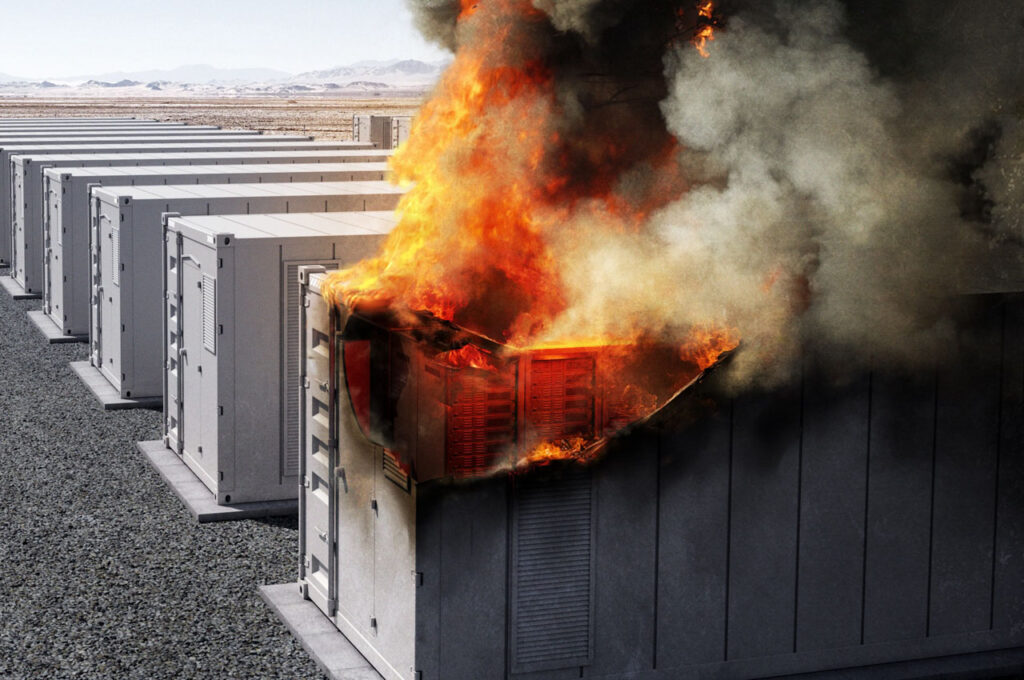
Lithium battery fires are one of the most critical safety challenges in modern energy systems.
While many fire extinguishers claim to be effective, real-world fire test performance tells a very different story.
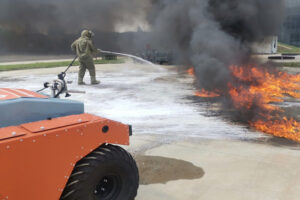
In this test, we compare aerogel-based fire suppression with traditional fire extinguishers in a controlled lithium battery fire scenario.
Test Overview
To evaluate real fire suppression performance, a controlled lithium battery fire test was conducted under standardized conditions.
Test Setup:
- Fire Source: Lithium-ion battery module
- Ignition Method: Thermal runaway initiation
- Environment: Semi-enclosed test space
- Comparison Agents:
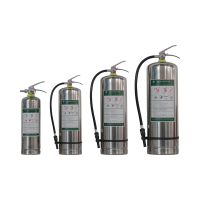
- Dry powder extinguisher
- CO₂ extinguisher
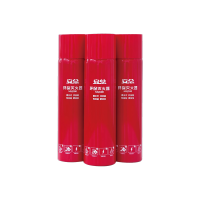
- Aerogel-based fire suppression agent
The objective was to evaluate:
- Extinguishing speed
- Cooling performance
- Re-ignition behavior
- Smoke suppression
Test Results: Traditional Extinguishers
Dry Powder
- Rapid flame knockdown observed
- No effective cooling of battery cells
- Thermal runaway continued internally
- Re-ignition occurred within minutes
CO₂
- Flames temporarily suppressed
- No penetration into battery structure
- Ineffective in stopping internal reactions
- Fire re-ignited shortly after discharge
Key Problem Identified
In both cases:
- Surface flames were suppressed
- Internal battery temperature remained high
- Thermal runaway continued
This confirms that traditional extinguishers do not address the root cause of lithium battery fires.
Test Results: Aerogel Fire Suppression
The aerogel-based extinguishing agent demonstrated significantly improved performance.
Observed Performance:
- Rapid flame suppression within 2 minutes
- Significant temperature reduction
- Penetration into battery structure
- No re-ignition after extinguishing
Why Aerogel Performs Better
Aerogel fire suppression works through a combined mechanism:
1. Rapid Cooling
The agent quickly absorbs heat and reduces internal battery temperature.
2. Oxygen Isolation
It forms a stable barrier that prevents oxygen from sustaining combustion.
3. Anti-Reignition Protection
A protective layer remains after extinguishing, preventing reignition.
Smoke and Toxic Gas Reduction
Another critical advantage observed during testing:
- Significant reduction in visible smoke
- Improved air clarity
- Lower risk of toxic exposure
This is particularly important in enclosed environments such as:
- Battery storage facilities
- EV charging stations
- Underground infrastructure
Real-World Implications
This test demonstrates that not all fire extinguishers are suitable for lithium battery fires.
For industries relying on lithium battery systems:
- Surface suppression is not enough
- Cooling and internal control are critical
- Re-ignition prevention is essential
Recommended Applications
Based on test performance, aerogel fire suppression is highly suitable for:
- Battery Energy Storage Systems (BESS)
- EV charging infrastructure
- Electric vehicle facilities
- Data centers with backup batteries
- Industrial battery applications
Conclusion
Traditional fire extinguishers may suppress flames, but they fail to stop thermal runaway.
Without effective cooling and re-ignition prevention, fire risks remain high.
Aerogel-based fire suppression provides a more complete and reliable solution for lithium battery fire protection.
Request Detailed Fire Test Reports
Looking for verified fire test data for your application?
- Get full test reports and performance data
- Request customized fire protection solutions
- Speak with our technical team
Contact us today to learn how aerogel fire suppression can improve safety in your facility.