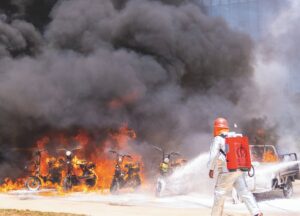
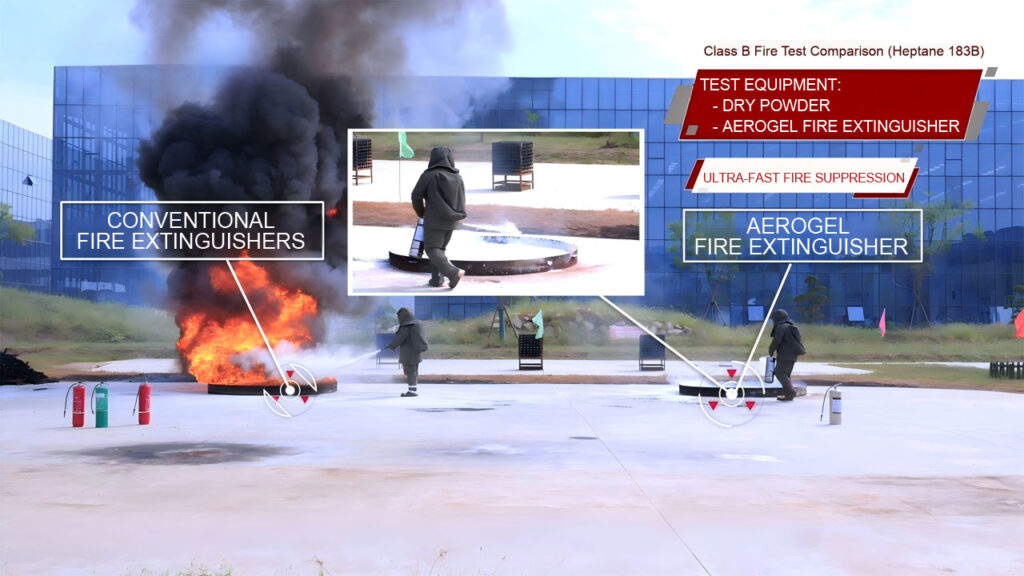
Choosing the right fire extinguisher is critical — especially in industrial environments where fire risks are complex and high-value assets are involved.
From oil fires to lithium battery incidents, not all fire extinguishers perform the same.
In this guide, we compare four major types:
- Foam extinguishers
- Dry powder extinguishers
- CO₂ extinguishers
- Aerogel-based fire suppression
Understanding their differences can help you select the right solution for your application.
Overview: Four Types of Fire Extinguishers
Each fire extinguisher works based on a different principle:
- Foam: Covers fuel surface and blocks oxygen
- Dry Powder: Interrupts chemical reactions in flames
- CO₂: Displaces oxygen in the air
- Aerogel: Combines cooling, isolation, and anti-reignition protection
Foam Fire Extinguishers
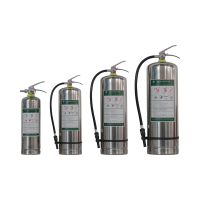
Foam extinguishers are widely used in liquid fires such as oil and fuel.
Advantages
- Effective for Class B fires (liquid fires)
- Covers surface to reduce oxygen contact
Limitations
- Foam layer can break down under high temperatures
- Requires continuous application
- Sensitive to fuel contamination
- High consumption in large-scale fires
In many petrochemical scenarios, foam systems lose effectiveness due to instability and system complexity.
Dry Powder Fire Extinguishers
Dry powder extinguishers are commonly used due to their versatility.
Advantages
- Fast flame knockdown
- Works on multiple fire classes
Limitations
- No cooling effect
- Cannot prevent re-ignition
- Leaves residue that damages equipment
- Poor performance in enclosed or sensitive environments
Dry powder is effective for immediate suppression — but not for long-term control.
CO₂ Fire Extinguishers
CO₂ extinguishers are often used for electrical fires and enclosed spaces.
Advantages
- Clean agent (no residue)
- Suitable for electrical equipment
Limitations
- Only displaces oxygen temporarily
- No cooling effect
- Ineffective for deep-seated or high-temperature fires
- Fire can easily reignite
CO₂ works best in controlled environments — but struggles in open or high-energy fire scenarios.
Aerogel-Based Fire Suppression
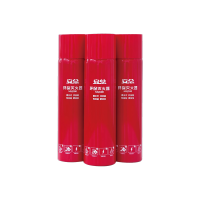
Aerogel fire extinguishing technology represents a new generation of fire protection solutions.
Unlike traditional methods, it addresses multiple fire factors simultaneously.
Advantages
- Rapid cooling reduces fire temperature quickly
- Forms a stable barrier to isolate oxygen
- Strong adhesion to fuel surfaces
- Prevents re-ignition
- Effective across multiple fire classes (A, B, E, F)
Key Performance
- Extinguishes lithium battery fires in ≤ 2 minutes
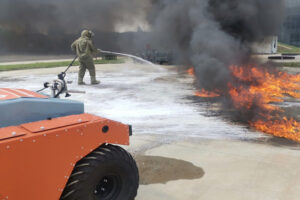
- Can suppress oil fires within seconds
- Maintains long-term stability after application
Direct Comparison
| Feature | Foam | Dry Powder | CO₂ | Aerogel |
|---|---|---|---|---|
| Cooling Effect | Medium | None | None | Strong |
| Anti-Reignition | Weak | None | None | Strong |
| Stability | Low | Medium | High | High |
| Residue | Medium | High | None | Low |
| Multi-Fire Capability | Limited | Medium | Limited | High |
| Industrial Suitability | Medium | Medium | Limited | High |
Which Fire Extinguisher Should You Choose?
The right choice depends on your fire risk:
For Oil & Petrochemical Fires
Foam is commonly used — but advanced solutions offer better stability and efficiency.
👉 Recommended: Aerogel-based suppression
Explore oil fire suppression solutions →
For Lithium Battery Fires
Traditional extinguishers are often ineffective.
👉 Recommended: Aerogel-based suppression (anti-reignition required)
Learn more about lithium battery fire risks →
For Electrical Equipment
CO₂ may be suitable for small, controlled fires.
👉 For larger risks: advanced suppression solutions are preferred
For Industrial Facilities
A single-solution approach is more efficient.
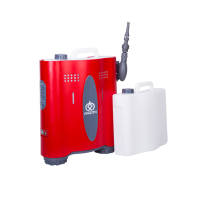
👉 Recommended: Multi-purpose fire suppression systems
Conclusion
Traditional fire extinguishers were designed for simpler fire scenarios.
Modern fire risks — especially in energy, petrochemical, and industrial environments — require more advanced solutions.
Aerogel-based fire suppression offers a comprehensive approach by combining:
- Cooling
- Oxygen isolation
- Re-ignition prevention
This makes it a strong alternative to conventional extinguishers.
Need Help Choosing the Right Fire Protection Solution?
If you’re evaluating fire protection options for your facility:
- Request a comparison report
- Get expert recommendations
- Explore customized solutions
Contact our team to find the right system for your application.